In episode 184 of the weekly Hump Day Hangouts by Semantic Mastery, one viewer asked if there is a silo structure package that one can buy in Serp Space.
The exact question was:
Is there a silo structure package that we can buy to help get help with this? Thanks for the feed Back! Joshua
Adam: All right. We are live. Welcome everybody to Hump Day Hangouts, episode 186. Before we dive into things, real quick, I want to say hi to the guys. We’ve got almost everybody here. If you’re watching this, we’ve got a lovely picture of Chris, I believe on the page, since he couldn’t be here live. But I’ll go down the road here, and say hello to everybody, real quick. Hernan, how’s it going, man?
Hernan: Hey guys. [inaudible 00:00:26] I’m out and about, but I didn’t want to miss it.
Adam: Fair enough. All right. Short and sweet. Marco, how’s the weather, man?
Marco: Weather is always good in Costa Rica. It’s warm, and raining, or warm, and sunny. No other option. I wouldn’t have it any other way.
Adam: Awesome. Bradley, how you doing, man?
Bradley: Neck deep in content production. I’ve been adding a bunch of content to the Local GMB Pro course, yesterday and today. Finally, got back to doing the prospecting module inside of the mastermind, which I’m so glad to be back working on that, again. For two days, I’ve been recording videos, and training, which I enjoy that stuff, in case you didn’t know. It’s good to be back to work and all that stuff, again. I’m happy to be here, and answer some questions, as well.
Adam: Nice. I saw the very top of your shirt, is that what shirt it is?
Bradley: Oh, yeah, this is-
Adam: Oh, very nice. Very nice.
Bradley: There we go.
Adam: There’s a couple ways to get those shirts. We’re actually going to be coming out with some new and improved stuff soon, so stay tuned for that. As well, if you are new to Semantic Mastery, and you’re watching Hump Day Hangouts, or this is one of the first times you watched this, first of all, thank you for watching, we appreciate everybody who checks it out, whether you’re lurking, and learning, or you’re actively asking questions. But, wherever you’re watching from you can always ask questions earlier by going to the event page, semanticmastery.com/hdquestions, pop in questions, or you can watch replays, there’s a lot of ways to get a ton of value out of these.
If you haven’t yet, and you’re new to us, we always recommend that you start with the Battle Plan, just go to Battleplan.semanticmastery.com. Speaking of where to start, a little further down the road, we’ve had a launch this past week with Local GMB Pro. People have had some awesome results. I mean, obviously if you’ve seen the sales page, of course we put the testimonials on there, but we continue to hear good stuff from people, and again, it’s not just us that are having these results. But not only that, Marco, I believe there’s some more stuff coming out for the people who joined and are part of the Local GMB Pro group right?
Marco: Actually, I’ve recruited 10, it’s going to end up 10 to 15 beta testers for our Google GMB auto poster, and then the image, renamer, and exit data, optimizer, if that’s what you want to call it, Spam Nation at its best. We’ve also got the YouTube views going, we were beta testing that, guys, we’re just a couple weeks away from making it available to everyone. Anyone that wants part of this, stay tuned, stay abreast of everything we’re training the Local GMB, the done for you.
I’ve been so busy that I’m kind of like Bradley, he’s producing content, I’m in the background trying to put everything together. Right? Trying to get all the software up. Trying to train people. Trying to stay abreast of the beta testers. We’re going to have a webinar on Monday to show them how to the GMB auto-posting, that’s going to be part of the training. Right? The video that come with the auto poster, that has a little bit higher learning curve. YouTube is pretty straightforward, you go in, and you place your URL, you chose where you want it to go, and it just goes and it gets you views. Real people. Real people. Did I say that enough? It’s real fucking people.
Bradley: Damn. Okay. You heard it first-
Hernan: I’m not entirely sure what you said, Marco. Was it real people? Was it [inaudible 00:04:07]?
Marco: [inaudible 00:04:10].
Bradley: G-rated, man. This is the public event.
Adam: Good deal. Bradley, I know you’ve been busy in there too, getting a lot of content in the training, and all that in there. Thank you, personally for that, as well. I know everyone is happy about that.
Bradley: Yeah. You know, my only regret is that is launching these products is great, the method is fantastic. It works really well. What sucks is it’s taking me away from some of the mastermind training for a couple of weeks, while I was working on content. We’re far from complete with the training, guys, we’re still adding a lot to it. Don’t think that what’s there is it. I’ve got more training. I’m adding, I’ll probably add several more videos tomorrow. I added a bunch of stuff yesterday to the Local GMB Pro member’s area, and we’ve got several update webinars coming up.
Just keep in mind there will be more and more content being added. Like I said, I’m glad to be able to start kind of pulling back a little bit from that, and start working on some of the other content, because I’ve got a lot of stuff that we’ve got to get out for you guys, for our members. Just bear with us while we do it guys. Everything that we’re coming out with has been tried, trued, and tested. There’s a reason why sometimes there’s a little bit of a delay in getting published, or getting out to you guys.
Adam: Awesome.
Marco: If I could just add to what Bradley just said, and I posted this in Facebook, we’re scratching the surface right now on what’s possible. All that we have right now is what we’ve been working with. Right? The Local GMB optimizing, the image manipulation, and activity. Activity inside the GMB ecosystem, but you guys know that we have a whole bunch of products, a whole bunch of courses that we use ourselves, that we haven’t implemented on. We had a testimonial just recently, the day before yesterday, 170 calls a day, excuse me, 170 calls a month in the dental niche, guys. A 170 calls a month. That dentist is knee deep in teeth.
Bradley: Yeah. One other thing that I just want to mention about it, for example, yesterday I started the silo training in there, and one of the things I’m going to be doing over the next couple days is finishing the silo training, and showing how to boost that using press releases, which is exactly what Marco was talking about, was integrating some of the other methods that we use to kind of help super charge the results. Essentially, this will be kind of integration between Local GMB Pro, and Local PR Pro to help get even better results, or quicker results. I’m going to be going over that within the next couple of days, if not by the end of this week, by the beginning of next week I’ll have that content added.
Then, one other thing I’m going to be doing is setting up some AdWords, you know some AdWords campaigns to be able to generate some additional traffic into the GMB Pro ecosystems, essentially. There will be some slight AdWords training in there, guys, for how to use that for Local GMB Pro methods, as well. That’s what Marco was saying is so far all the training is just about being inside the GMB dashboard, and you can still accomplish, or get results from staying within the GMB dashboard, and not integrating other services.
However, we’re going to give you guys all the stuff that we test that works, that produces results, and that includes back linking, other traditional SEO stuff, sending traffic, including PPC traffic. All different kinds of things that we’re going to be adding into the training to be used in tandem with the Local GMB Pro, exclusive methods, if that makes sense. Again, there’s lots and lots of additional content. It was only a one time purchase price, it’s not a recurring, but we’re still going to be adding more content to it as we develop out more of these methods.
Adam: Sweet. All right. Anybody else, last call? Then, we’re going to jump into it, here. Going once, going twice. All right. Let’s get into the questions.
Bradley: Did you tell everybody to subscribe to our YouTube channel?
Adam: Yeah. Hey, everybody, subscribe to the YouTube channel. For multiple reasons, we do put out other content, and it’s a great way to stay up to date on Hangouts, because we get it, you can’t always make these live, or you ask a question, and you’re busy, something happens. Yeah. Do us, and yourself a favor, and subscribe on YouTube.
Bradley: Fantastic. All right.
Hernan: Yeah. If I might say, there’s a gold mind of information on that YouTube channel, and a lot of people are actually charging a lot of money for the information that you can find on YouTube, so go ahead, and use, Marco usually says, go ahead and use the search function on YouTube, before coming and asking your question, here, I don’t know, I would say six times out of 10 you will find your answer there. You can still come and ask questions, but that’s a really powerful resource, and it’s free. It’s there. You know?
Bradley: I see you guys updating YouTube Silo Academy videos in there in the channel, somebody is in there doing that, and God all mighty, that was years ago, and I look like a different person, now. I’m seeing those videos, I’m like, oh, God, I need to rerecord all of those, because, I’m half the man I used to be, literally.
Adam: Yeah. That’s some extra bonuses for some Battle Plan people, so people who get the Battle Plan bundle are getting some extra special goodies when they get in there.
Bradley: Wow. All right. Let’s go ahead and get into questions. Can we do that?
Adam: Let’s do it.
Do You Need To Comply With The GDPR To Your Local Lead Gen Sites?
Hernan: Yeah. If might, and there’s a lot of debate still on the GDPR side of things, and then there’s Chris saying you hide with a wig, and saying you [inaudible 00:10:22] screen, so that’s his response. In short, what you need to do is that just to put it that we are not lawyers, I’m not a lawyer, so you need to have that in mind. What we found is that you need to make people aware that if you’re giving them something you need to have their expressed consent for you to market them something else. Right?
For example, let’s say that you’re giving away something for free, like a free, I don’t know, teeth whitening, or something like that to sweeten the deal, and you want to add a checkbox on whatever it is that you’re doing, click box, sorry, click funnels, or whatever, you want to add a checkbox over there that says, “I also want to get marketing or promotional material from this company.” You know? That’s basically it. That’s basically all you need to do right now to be compliant.
With that said, there’s still a debate going on, and personally, and this is a 100% a personal opinion, don’t take it as advice, I think that they’re going to go for the big dogs first, because if yours is just conducting normal business, and getting I don’t know a handful of leads, maybe I don’t know, 200 leads a month, or something like that, you’re not even a target. They’re going to be going after the big lead gen companies, and everything like that, before going, and then we will see how that develops before being completely structured on what we need to be doing in terms of GDPR. What do you think, Adam?
Adam: Yeah. I think, too, the thing to keep in mind with this is, hey, do the right thing, if you’re doing something shady, if you’re not telling people you’re going to send them emails, things like that. Get that stuff in order, but the main, for us, at least is again as I understood it, because there’s a lot of interpretation here, GDPR is to deal with data storage, and privacy. I realize on a sharp end of the stick for us that usually comes down to how you handle emails, but GDPR was not created to deal with peoples lead magnet funnels, or things like that. It’s more about what are you doing with that information? Can people get that information? Can they delete it from your system? That’s what it’s more about. Just keep that in mind, but I agree with what Hernan was saying.
Bradley: Yeah. My only advice would be, for example, I don’t know how to apply this, yet, [inaudible 00:12:38], to local stuff. I don’t know where we need to apply it, or when, or how. I’m just kind of waiting to let some of the dust settle, and let the big guys figure it out, and then it’ll trickle on down to the little old me. You know what I mean? That’s basically why I don’t have an answer for you on that. I know it’s something that I will also need to be concerned about being in the local lead gen space as well, but it’s not something that I’m going to worry about currently when it’s still a bunch of craziness as you mentioned in your comment, because it really, truly is.
It’s real foggy. It’s murky right now. I don’t know of anybody that knows all the answers, yet, but in time it will work itself out, and I’ll start to implement whatever I need to at that point. But, I’m not really super concerned at the moment, because I don’t do anything super spammy to email subscribers. At least not for local stuff. Right? Anyways, that’s my thought on it.
Hernan: Yeah. I totally agree with you Bradley, but one more thing that you need to have in mind is that whatever you’re using, whatever tools you’re using to collect your emails, you know, we usually go with Drip, in [inaudible 00:13:47] case we use ActiveCampaign, we use Click Funnels, and whatnot, you need to make sure that whatever you’re using they are GDPR compliant. You know? That’s up to you, as a data manager to make sure that everyone that you’re using, every service provider, your email responder, your landing page builder, whatever you’re doing is GDPR compliant.
The good news is that most of the stuff, if not all of the stuff that we teach you guys, or that we recommend, like Click Funnels, Thrive, ActiveCampaign, Drip, you know the bigger, the biggest tools out there they are already compliant with GDPR, so there’s not a big deal over there, but if you have questions about this and that provider, you can always reach out to them and tell them, “Hey, guys, are you GDPR compliant?” Because most of the big companies they have already done their homework, because those are going to be the big targets.
Bradley: Right.
Hernan: You know? Not the small guy, but for example, ActiveCampaign. Those click funnels, that they’re handling millions of emails per month, pretty much.
Marco: All right. If I could i just clarify a point, because he’s asking a local lead gen site in Florida, the European Union cannot enforce a European law on US soil, unless you’re targeting European Union members. As long as you’re just within Florida, or within the US, you could even go as far as Latin America, there is no GDPR law in Latin America. You could target that. The moment that you start getting people from the EU, for whatever reasons, I don’t see why you would in Florida.
Why someone in Germany would want your services in Florida, since you’re local, you can’t go to Germany, and service whatever it is that they want, or France, or whatever. Local, it doesn’t apply, you’re within the US, you’re bound by US laws, not European Union. Now, as far as Semantic Mastery, it’s a global company, we accept people from all over the world, including the European Union, so we have to abide by GDPR, and that’s the distinct difference. It’s whether if it’s within the boundaries of the European Union, or if you’re doing financial transactions, even if you’re outside the European Union. You have to provide GDPR protection to that information.
Hernan: Yeah.
Marco: I hope that clarifies it a little bit.
Hernan: Yeah. I totally agree with Marco, as well. I do see this as an effort, or you know when you, even if you’re not reach out, because I totally agree with Marco, what Marco is saying in terms of if you’re doing business in south Florida, or something like that, you are technically not reached by the GDPR, but I do think that, not yet, but Facebook, AdWords, et cetera, as they are asking you to have a privacy policy, et cetera on the footer, to make your ads compliant and whatnot, they’re going to start enforcing that.
That’s not happening as of yet, but I think at some point that’s coming, and it has to do with being able to advertise on these platforms that we know what we’re doing in terms of Facebook, or AdWords, we need to be compliant, because as Marco was saying, we get a lot of leads, and a lot of people from Europe, but it’s coming at some point, so I think it’s better to be prepared.
Should I Create New Folders For These Docs Or Simply Add The Docs To The Main RYS Folder?
Marco: Oh, yeah. No. I’m not going to get into how we do the folders, and how we silo, how we do everything.
Bradley: Yeah. I didn’t think that would be one you’d want to answer in a public setting. Click Star Marketing, sorry I don’t know your real name, off the top of my head, but I would direct you to ask that question, repost it in RYS Reloaded members area, or the Facebook group, I mean. Marco, and/or Rob would be happy to jump in and answer it there. Okay? Sorry, guys. That’s one of those types of questions that we just can’t answer here, because it’s revealing too much information from one of our higher priced courses.
How Do We Know That Users Actually Call The Tracking Number In A GMB Listing?
Gordon. What’s up buddy? He’s here almost every week now asking good questions. He says, “Hey, I want to say a big thank you, or big, and huge thank you, again, for the help you provide your customers on these Hump Day events.” We truly enjoy it, Gordon. It’s funny, but we had our corporate meeting yesterday, which we do every week on Tuesday, and we were talking about several years down the road, like what our plan is for Semantic Mastery, and Marco was talking about his age and his family, and talking about how he doesn’t want to constantly be in the lab developing new stuff, and providing, you know, producing training, and all that stuff, but one of the things that he says he would like to still do far into the future is Hump Day Hangouts.
I feel the same way. We’re almost on our fourth year, where at what episode 186 today, I think it is? We’re only a handful of episodes away from being on our fourth year anniversary. This is something that we truly enjoy. It’s kind of a way to give back, you guys have been good to us, we try to be good to you, and this public setting, one hour a week, every single week. We certainly appreciate you coming and participating every week, as well.
I’m not a 100% clear on that one. Marco, could probably give you an answer on that. I know you can add additional numbers, and there is an AdWords tracking number, or tracking extension, or something like that inside GMB, but that’s different, that’s if you’re going to be using the location extension inside of AdWords, so you can designate a specific tracking number there, so that you can call analytics through that one number. Right? That’s something that’s displayed via an ad. As far as the numbers as part of the NAP, I know you can add additional numbers, so you can have the primary number, and then you can have secondary numbers, but I’m not sure how you can designate one over the other, or if that effects NAP. Marco, what is your take on that?
Marco: Yes. You can absolutely make another number the primary number. That of course is going to effect your NAP, so you’re going to need NAP cleanup. Now, you can eliminate the second number, you don’t have to keep the second number. That’s not going to change anything, since there’s still a primary number there. Again, what that will change is the NAP. If you don’t want people to see the clients, or your SEO clients number, then you want them to see your tracking number then you’re going to have to display your number. What I’d do is I’d display several numbers and then let kind of bury the clients number, if they insist on having their number on the title. I don’t see why they would, but you might get into that where a client demands it, if you don’t want to lose that number for whatever reason, you can still leave it on there, but yes, you can absolutely change the primary number.
Bradley: Do we have an example somewhere, because to be honest, I’ve never seen a GMB like a Google Maps listing that displayed more than one phone number. I’ve never seen that, at least what I can remember. Do we have an example of that somewhere? Or does Google only display one number, which is what I’ve always seen.
Marco: It could be that Google displays only one number, but you can add several numbers.
Bradley: Yeah.
Marco: I would have to go and look.
Bradley: My question would be then, what he’s asking, I think is if you use a tracking number, but you add the actual NAP number, so the businesses main phone number, but you add that as a secondary number, and Google displays the tracking number, although, Google, GMB is aware of the other number if all of the citations out there have the original number, but the tracking number is displayed in Maps, does that cause NAP issues? Is what I’m saying. Do we know an answer to that? I’ve never tested that.
Marco: No. Not a direct answer with whether it’ll cause issues, but just think, Google knows that the other number is there.
Bradley: Right.
Marco: But, yeah, no, I mean, we have to test it, and that’s a hell of a test.
Bradley: Yeah. It is, because you could literally tank a Maps listing if it does affect, or cause NAP issues. I get what you’re saying, Marco, and it makes sense to me, which is if both numbers are added to GMB, the Google My Business dashboard, then Google knows that, that secondary number, which might not be displayed is in the Maps listing, but Google understands that it’s connected with the business, so logically it shouldn’t cause any NAP issues, if the primary non tracking number was used in citations.
One of the things I can mention about this to maybe shed a little bit of light on here was from a Google help, one of my clients has two locations, and both of their locations, it’s a preschool, both of their locations had their physical address shown incorrectly. Essentially, you should go to the US Postal Service, or USPS.com in the United States, and they have a zip code finder, or whatever, and basically you can enter in an address, and it will give you the standardization, like the address formatted in the USPS, United States Postal Service approved formatting. Right? It’ll give you like the standard address formatting, the way that it should be.
One of the things I always do for my clients is I go in and double check what they give me as their address, with how the USPS shows it as the standardized address, and if there’s an inconsistency, which typically a lot of the times, more often than not, there is an inconsistency. I will end up updating the Google, the GMB address to match what the US Postal Service says should be the correct formatting. Then if it requires it I’ll go out and start a citation cleanup job to amend, or update all of the citations that are published to show the correct formatting of the address.
The reason I’m telling you this, because I contacted, the two locations in the preschool, I had to update both of those addresses in GMB to the correct formatting, because they were listed incorrectly. Right? Which was because the business owner had set it up the wrong way. I standardized the addresses, I updated both of them, but one location did not display the updated address. In other words, both locations updated in the dashboard, and if you want to go view the public Maps listing one location showed the updated address, updated format, address formatting, excuse me.
The other location didn’t show, it still showed, displayed the old formatting, although in the dashboard if you clicked info, and then you clicked edit, the info for that business, the NAP was listed correctly, saved correctly inside of GMB, but the displayed address was still the old address, which was the incorrect formatting, so I contacted GMB help about it, or support, and one of the support techs ended up replying back to me, and saying, “Oh, no. As long as it’s correct in the GMB dashboard, the display doesn’t matter. Google will associate whatever NAP mentions out on the web with what is saved in the dashboard.”
Now, keep in mind Google support reps don’t always tell us the truth, maybe because they don’t know themselves. I’m not sure that, that was a 100% accurate, but that’s what he told me, and I said, “Okay. Let’s not worry about it,” and I’ve never worried about it since, and that client is ranked number one, and/or number two for just about every keyword I’ve optimized for, even though the display address is different than what all the citations are, if that makes sense.
Because, again, in the dashboard, in the background, Google has it saved correctly, but the display is still displaying it the old way, and it’s never caused an NAP issue for me. For me, it stands to reason that having that additional phone number saved in the dashboard Google will make that association, but without testing it, I can’t say for sure. That’s a great question, by the way, Gordon. It’s a good one. If we’re giving away t-shirts today, he should probably get one, just saying.
How Do You Upload Copies Of The Same Video For Ranking Multiple Related Keywords Without Triggering A Duplicate Content Penalty?
They’ll change varies things to where it basically looks unique. I haven’t heard or seen anything about them checking the audio or the speech within the video. That might be something new, which again I haven’t seen that, Gordon, or read anything about it, although I haven’t been doing a whole lot of reading about YouTube stuff recently, so that could be part of it. The only thing I would say is just keep doing what you’re doing until it becomes a problem, at which point I’m sure there will be plenty of SEO spam tool developers out there that will create stuff that will get around it.
Guys, anytime Google makes a change to stop us from doing stuff, it’s just a matter of weeks before we have new tools, and new services out there that exploit other loopholes. Right? I wouldn’t worry about it right now. That’s a what if question, really, until you start to experience it, at which point I’m sure there will be plenty of people with solutions. Okay? You guys have any comment on either of those?
Marco: No. I like it. I’m just thinking how you can just totally trick YouTube with varying the pitch on the voice to a frequency that’s not humanly recognized, but it’s recognized by the bot, so that would be a perfect way, I mean, whoever comes up with that tool, let me know, I’ll be first in line to buy it. It would be really simple to put voiceover in there, to just add a second audio to the video that’s not recognizable to humans, but it’s totally recognizable by the bot, and now you have two distinct audio recordings.
Bradley: Yeah. I’m wondering, in fact, if they have … I’m just curious, because they have video spinners and there’s content spinners, I wonder, I’m sure somebody might make an audio spinner. Right? Something that would change an audio file to what Marco just said different frequencies, different pitches, that kind of stuff that would make it unique. I’m sure if there’s not one yet, and that is going to be an issue with YouTube, somebodies going to make one. I promise you that.
By the way, I’m sure all of you guys are subscribed to a 1,000 internet marketing developers lists, many of which you probably never subscribed to, but because you were on an email list that got sold to other marketers, I get them all the time, I get spam emails that I’ve never subscribed to all the time for stupid warrior form, or plus products, and JVZoo products, and stuff, and I have to unsubscribe all the time. How many of you guys have been getting email after, email after email about all these new YouTube tools that are coming out? Right? Or, excuse me, video creation tools.
I don’t know about you, but it seems like over the last couple of weeks I just keep getting, it’s like almost daily there’s another video marketing tool that’s being launched. Every single time it’s another freaking stupid email about, it’s the next coolest video marketing tool, it’s the easiest thing in the world. I just get tired of deleting all those emails, guys.
It’s like a new shiny object every day, and it’s like, this one is better than all the other tools on the market, and they say that every day. Right? I’m just so fatigued with video marketing tools, guys, that I just delete all those emails, now. I’m sure you guys can relate. It just seems like there’s a flood of video marketing tools coming out on the market right now.
Marco: I posted a link. Yeah, Bradley, I posted a link to Google cloud, so people can go in and play with the speech to text recognition.
Bradley: Cool.
Marco: You can see how sophisticated Google has gotten.
What Platform Should You Target When It Comes To Remarketing And Setting Up Tracking Pixels?
It’s so cool, because you can do so many amazing things with Tag Manager. Not just adding pixels, but so many other things, and for that, I would recommend this, I send people to this guy all the time, I should ask him if he’s got an affiliate program. This guys name is Julian, and his website is called measureschool.com, guys. He’s got some free training. Wow. How do exit out of this damn thing? Maybe you just got to click in here somewhere. Anyways, measureschool.com. I’ll put the link on the page.
He’s got some free training courses with just an opt in you can get, and he’s also got several courses on Udemy, or however the hell you say that, and he’s really, really good. I learned, I just got his Google Tag Manager course, I think it’s a free course that I got, that just specifically to learn the basics of Tag Manager, but he goes into great advanced Tag Manager stuff that can be done with it, which is really cool. It’s a lot of real geeky stuff that I’m probably never going to implement, because it’s way over and above my pay grade. But, you can tell this guy, Julian, he’s a total data nerd, and he’s proud to admit it.
I highly recommend that you go check out whatever resources he has available. Let me just post this on here. This is, yeah, look, Andy says, “I’ve been getting bombarded with video spam tools.” Right, Andy, or video creation tools. Yeah. I’ve seen a lot of those recently. I don’t know why. Measure School. Anyways, I would go check that out, guys. He’s got, like I said, some free courses that I’ve been through, at least the Tag Manager course.
He’s also got some analytics training that is super advanced stuff that you can do. I don’t know about you guys, but analytics is always been confusing to me other than just basic traffic tracking, but he goes into all kinds of great detail on how to do all kinds of stuff. I’d go check that out. As far as remarketing, like strategy, that’s probably going to be more of a Hernan question. Hernan, are you still on?
Hernan: Yeah. I’m here. In terms of remarketing, what we’re basically doing, Nigel, is the cheapest type of traffic that you can run right now no matter what you’re doing in terms of remarketing for Facebook, or AdWords, whatever, is the remarketing traffic, because the most expensive visitor is the first visitor, if that makes sense.
Bradley: Cool.
Hernan: Yeah. You know, you need to have that in mind, by getting a visitor back to a page it’s the best way to increase your ROI. Bam. Pretty much. The way we are doing it in Semantic Mastery it’s pretty [inaudible 00:34:39], we have a lot of video viewers on YouTube, so we’re retargeting video viewers, we do have organic visits to Semantic Mastery’s page, so we do retarget them on AdWords, and Facebook, because we have the Facebook and the AdWords pixel installed on the website. Then we run traffic from Facebook to the blog post, we do some video views, we do some video view campaigns on Facebook, as well. We remarket everyone, like everyone into the top of the funnel entry points, or funnel entry points, like the Battle Plan, or the IFTTT recipes, et cetera. We talked a little bit about remarketing on local ads for Facebook, we probably will be touching base as well when it comes to video ads.
Bradley: Yes.
Hernan: Because I think that video ads is one of the best way, at least on Facebook, and I think on YouTube, too, but it’s one of the best way to build a big audience fast, by cheap, really cheap. We’re going to be touching base back on that on the mastermind, as well. But that’s basically how we’re doing it. We’re getting traffic through several entry points, and then we re-target them all into specific funnels that we have predetermined to [inaudible 00:35:56] all traffic, or remarketing traffic, if that makes sense.
Bradley: Yeah. A couple things, just quickly. We’re also remarketing via, he was talking about Facebook, and video views, but just to clarify, we are also doing YouTube remarketing, and also Google display network remarketing, which as banner ads. Guys, just keep in mind-
Hernan: Yes.
Bradley: Those are all the different, we use Facebook, YouTube, and GBM, Google-
Hernan: Yeah.
Bradley: [crosstalk 00:36:20] work for remarketing, right now.
Hernan: Yes.
Bradley: Are we using thing like Perfect Audience, or AdRoll, or anything?
Hernan: We’re using AdRoll. We were using AdRoll not as a lot, because usually with Facebook, and Google, and GDN we’re usually good, but here’s the thing, you can re-target people that have watched a video, and you can follow him around on the GDN, you know, the Google Display Network, and then you can follow him around on Facebook, as well, and vice versa. They can watch a YouTube video, and then they see a banner surfing around, or if they have watched a video on YouTube, they get a banner on Facebook, so we’re kind of all over the place, and you will get that.
Bradley: Yeah.
Hernan: We got that a lot on the [inaudible 00:37:02] event that Adam and I were there, and we got a lot. Like, Hey, guys, I saw a video from Semantic Mastery, where I attended Hump Day Hangout, and-
Bradley: That’s awesome.
Hernan: “Now you’re popping up all over the place.” Yeah. I thought that was pretty cool.
Bradley: Short answer, Nigel, this shit works, by the way.
Hernan: Yes.
Bradley: Remarket heavy, like go hard, go very aggressive with remarketing, in fact, I started adding, like I said, more training to the prospecting module in the mastermind, Nigel, and I know you’re in the mastermind, and we’re going to be talking for the prospecting funnels, we’re going to be talking about how, because I’m going to be really aggressive with remarketing for people that we drive into the funnel, the prospecting funnel. I’m getting pretty granular as to where they’ve exited the funnel, so that the messaging sequence would be very specific to where they exited the funnel. All of that will be covered in great detail, and the prospecting funnel built out, which is the training that I’m starting back up, just now. Just pay attention to that, Nigel. Those are some great questions we can cover more in the mastermind webinars, too.
Are There Any Major Pitfalls One Should Be Aware Of When Setting Up Pixels / Remarketing?
When somebody lands on a page, now, there are things like Rebrandly, or I know there’s Sniply and things like those types of link shorteners that you can inject a remarketing pixel into the actual link itself, the redirect URL, goes into the header of the actual URL, itself, so you can do that, but most of the time you’re going to end up having your remarketing pixels on the pages that you’re directing people to, unless you’re directing people to pages that you don’t have access to, through like a Sniply or a Rebrandly link.
Which in that case maybe Hernan can shed some light on that, but as far as the type of remarketing that I’m doing, it’s typically on an asset, like I cookie somebody when they land on one of the assets that I have control over, so that’s how I can manage, and that doesn’t ever cause any conflicts with analytics, or tracking, and affiliate links, and things. At least, from my experience. If you’re using the redirect URLs and injecting a pixel into that, then that might cause some issues. What do you think, Hernan?
Hernan: Yeah. Sorry, I was muted. Yeah. I totally agree. They’re mostly the sign for them to work and it’s actually adding scripts to a page. Right? Once they load they will try everything, like your adding scripts, and even further if you’re doing analytics with remarketing on Google, you can even use the analytics code to gather a remarketing audience, if that makes sense. That’s really integrated, and even if you were using Google Tag Manager, that would make things so much easier, but it all comes down to loading the page.
If the page doesn’t load, it doesn’t matter what you do, if the page did not load, and some ad blockers will actually block some cookies, so you need to have that in mind, but for most cases you don’t need to worry about it, because if people are actually surfing your website, they’re getting cookie. I wouldn’t sweat it initially of conflicts, and whatnot, if you’re doing things, like if you’re installing the code in the header, or the footer of the website, that’s why we recommend for example on Facebook recommend doing actual view content campaigns, and not click campaigns, because usually you’ll get a click, but the pixel will not load, because people exit earlier, or whatever. Yeah, usually it’s not a big deal.
Bradley: Nigel, if you want for us to try and go in a little bit more in depth, we’re having a mastermind webinar tomorrow, so if you want to repost the mastermind questions forum some of the stuff that we didn’t get to here, we got to move on, buddy. We’re certainly happy to spend some more time with you tomorrow during the mastermind webinar. Lastly guys, he mentions here that he’s a writer looking to connect with anyone interested in sweat equity partner for GMB Pro or other content posting and process documentation. If interested, please reach out.
By the way, if I could Plus one this again, I would, Nigel, because that’s what we really encourage more of you guys to do, is to put out what you’re good at, and what you lack, or like what you’re not good at, and try to form JV, joint ventures with other members, because two heads can usually accomplish a lot more than one. Right? You can compliment each others skills that way, and actually produce a joint venture, or partnership agreement where you can grow your businesses, or compliment each other, like help each other out. That’s basically how we got started at Semantic Mastery, guys.
Again, I really like that you posted that there, Nigel, and I would encourage more of you guys to do that, not just on Hump Day Hangouts, but even in the groups, too. Say what you’re good at, say what you’re not good at, and say, “Look, if there’s any potential for us, for anybody in this group that wants to kind of exchange ideas, and maybe do some projects together, or whatever.” Guys, there’s a great opportunity for you to be able to build and scale your businesses so much quicker that way. Right?
Just keep that in mind. Instead of having to learn how to do everything yourself, and have to become an expert at everything yourself, find other people that are good at things you’re not good at, and the two of you can compliment each other, and grow your businesses quicker that way. Does that make sense? Anyways, that’s awesome, Nigel, I appreciate that.
Can The Google My Business Website Just Be A 2000 Word Article About A Business?
I would recommend, yeah, putting good content on the page, but then the way that you add, or update content is through the GMB posts, and that does it automatically. You just add posts, and it will automatically add the posts to the actual GMB website, but at least as it stands right now as far as I know, unless Marco corrects me, here, the GMB website is one page.
Marco: It’s a single page site, Bradley.
Bradley: What I would recommend is if you need to have a website, an external website where you’ve got pages, which I’m not saying don’t do that, guys, we talked about the GMB Pro training, or method where you can stay entirely inside the GMB dashboard. Right? That’s fine, you can, but there is certainly a benefit still to having an external website, so that you can do what you’re talking about, here. List your services, having categories, and silos, if you need to, and all that other kind of stuff. That’s what I would recommend an external website for. Okay?
Any Tips On How To Use Tracking Phone Number With The GMB Account?
You can always add, if you’ve got a service provider, or a client, if you’re setting up a lead gen property or asset for a client, and they have their original business number that you want to include as a secondary number, yeah, you can do that, but if you’re setting up a new listing from scratch that you’re going to be managing, whether you own the asset or the client owns the asset, it doesn’t matter.
If you’re going to be managing it, and you can get the client to agree, if it’s a client, or if it’s your asset, they don’t even have to agree. Right? Because it’s yours. I would absolutely recommend using a tracking number. Okay? If you’re setting it up for a client, I would still recommend that you use a tracking number, so that you can quantify your results to the client, and then have their number as a secondary number. All right? Okay.
Do Internal Links That Point To The Money Site Have Negative Effect On Syndicated Content?
Technically, because it’s your own content that you’re republishing. Typically, if you’re going to republish somebody else’s content, you’re not supposed to republish the whole work, or the whole piece, anyways, you’re only supposed to republish a portion or a snippet of it, but you’re always supposed to cite the source. That’s to be within DMCA compliance as well as it’s just the right and ethical thing to do. Right? Just to give credit to the source. No, it doesn’t create a problem.
Is There A Way To Add The Exif Data To The Photos Without Downloading And Re-uploading Them?
Marco: No. What we have is we have to download the images, so that you can rename and play with exit data. What I would say is, if the client did it, it’s likely that he did it either from home, he, or she, or from the business, or from things surrounding the business, or whatever. You actually want that, because that’s really good local information on those images already.
Bradley: Unless they were stock photos.
Marco: Yeah. Unless it was stock garbage, or unless he grabbed them from the web, and he didn’t know what he was doing, and you can get into a lot of trouble with those extortionists, I forget them, I can’t, [crosstalk 00:47:26]-
Bradley: This is one of them.
Marco: There you go, they’re extortionists, man.
Bradley: Yeah.
Marco: But, other than that, no. Ask your client, where they came from, if they came from his phone, and we have all their local information, you don’t need anything else. You actually have a little gold mine there that you can reuse.
Bradley: Yeah. You know, I have trouble getting the clients, even though they all say, “Oh, yeah. We’ll get you some photos,” it’s like pulling teeth, getting my clients to give me photos, so I just set up my VA with a Stockfresh account, and she just goes in and pulls stock photos, and then she basically renames the file names, and changes the exit data, adds geo data, all that kind of stuff, and then we upload them. That’s just because, again, even the clients that swore up and down they’d get me photos, not a one of them has sent me any damn photos. It’s ridiculous. I just gave up. It’s hard to get clients to contribute, or to participate, I don’t know why.
What Are Your Thoughts On Meta Refresh On Google Sites?
I don’t know how he’s getting away with it, because I haven’t played with that software, guys, honestly, I just haven’t had time. I’ve been overwhelmed with local GMB Pro, and the mastermind training stuff, so I don’t have time to play with any software, right now. At all. However, I know that he’s recently launched that software that integrates with the Google Sites Generator that does exactly that. It creates Google sites in mass, and then it adds a meta refresh, redirect, to them, so that the Google sites rank, but when someone clicks on it, it redirects to whatever destination URL they want. That’s totally against terms of services, as far as I know.
Again, I can understand why it might have gotten an account banned. Somehow, his tool is still doing that, and I’m a big fan of Peter’s tools, guys, just in case you weren’t aware of that. Peter Drew’s tools are really, really good. Even though I haven’t had a chance to play with it, I would like to, so I’m not sure. Again, it’s probably against terms of service. Marco, I know you had figured it out, but you don’t use it, is it because of that reason?
Marco: No. I do use it. I’m just really careful that I’m not seen as a phishing site, P-H, phishing. Right? Where I’m going from a contact forum to another place that holds the contact form, that’s a big freaking no, no, and yes, you’ll get everything taken down, down to your pants, man. They’ll get you for that, because that’s phishing. You going to another contact form, somewhere other to reach other people that’s seen as a trick to get their information.
Now, I’ve seen, literally, a website with thousands of pages, and I don’t know how they did it, Peter [inaudible 00:50:39], but just hundreds and thousands of pages, and then a refresh over to pages on the main website without any issues. It’s just the page that you meta refresh, you have to be really careful what that page is about. Since our pages are usually just iframes, we have really no issues with the meta refresh. I mean, I talk to Rob back and forth, and our G sites are namely that, not just content, and just a bunch of iframes. No, no problems.
Is There Any Viable Use For Crowdsearch.me Any More?
Bradley: Yeah. Okay. Cool. Let’s see, question number two is, “Is there viable use for Crowdsearch.me, anymore? I’m considering dropping it, unless there is a use for it in some way. Thanks, in advance.” Yeah. I canceled my subscription several months ago, guys. There is still a benefit to using it in some situations, like for referral traffic through social media. The problem is credits are expensive over there, so I’ve used it in the past. I was on a 50,000 credit per month plan, so over time I didn’t always use all my credits, and I had actually backed up something like 400 and some 1,000 credits, so when I canceled my subscription, but I had built up over time, because I had been using that tool for damn near three years, I think.
One of the things that I was doing with it was sending traffic to press releases as part of the way to get PR’s to stick. Right? All that is covered in the Local PR Pro training on ways to get the press releases to stick. One of the ways is to send traffic to it. I would send Crowd Search traffic to it, but remember, I had hundreds of thousands of credits, so I would ramp it up to where I’d send dozens of views per day to that PR, so that it would help with the stick in the search results, and not start to slip after a few days, or a couple of weeks, or whatever, depending on how competitive the term was.
However, there’s fiber gigs that you can buy for five bucks, or 10 bucks, or even 15 bucks, whatever, to send traffic that has the same effect, and it doesn’t require a monthly subscription, it’s just a gig. You know what I mean? Then you can just re up the gig once a month, or whenever you start to see it drop. The short answer is, yeah, you can still use Crowd Search in some respects without it, I just wouldn’t run it to my money site, guys, anymore, at all, because a lot of those CT spam have been, like the IP ranges have been flagged, and all that kind of stuff.
A lot of that traffic is just disregarded. It’s just not counted, now. We know, because we spent six figures trying to develop a tool to do it, and I’m not kidding. We weren’t able to do it in any way that we would want to sell to you guys, and that’s why we never launched it. We never launched our traffic service specifically because we did a ton of testing, I mean, we spent a lot of fucking money, by the way, on this and we were not able to get it to something that we felt comfortable as selling as a service. That’s why we don’t use it ourselves anymore, and we didn’t provide it, ever launch it to you guys. Right? We’re out a lot of money over it.
My point is, I don’t think it’s a good idea, because there’s other ways, like I would rather spend the money and the time setting up micro task workers to do it, and even that’s not even all that great anymore, it’s still better than nothing, as far as being able to spam traffic, but it’s just not something that I would recommend doing. David, if you’re not using it the right way through referral traffic, and stuff like that, then I would say, cancel it. Your money is probably better spent somewhere else. Okay? Marco, do you want to comment on that?
Marco: Yeah. The problem with Think Traffic, and micro task workers as you referred to it’s user agents, repeated user agents, repeated IP blocks, because they buy IP’s that they send people to, and if you do that over and over I mean it’s just a big footprint. It doesn’t matter who it is. Additionally, a bot cannot mimic a real person, nor can a micro-task worker, because you’re giving micro task-
Bradley: [crosstalk 00:55:03]-
Marco: Worker a set of rules that they have to apply over and over again. They’re only going to do what they’re instructed to do, whereas a real person, think about it, think of it as an end user, sometimes you’re in the middle of something, and your kid falls, so you walk away, and you come back, how do you mimic that? How do you mimic that into whatever it is that your trying to produce, whatever effect? Whatever analytics, and metrics you’re trying to feed the bot. How do you account for that? How do you account for the human factor? The only way to account for it is through human, not micro task workers. Micro task workers are humans assigned to do a specific task.
This is what we’re seeing from our YouTube users, where we pull real people. They come in, they act real people, they interact with the channel in a natural way, and it just sends the signals that Google is looking for, it’s people interacting, they give you lights, they give you, they’re subscribing, they’re commenting on your video, but the thing that we’ve found, and this goes back to the spam videos that somebody talked about, if you use spam videos, don’t expect to get much action on the spam video. You have to make sure you’re sending real traffic to a video, you have to make sure that, that video is quality, and will convert, or else you’re just wasting your time. Either way, because now what we’re seeing we’re not concentrating so much on ranking, right? What we’re concentrating on is generating traffic wherever it is we want them to go.
Bradley: Yeah. I was just scrolling through, because we’ve got to wrap up here, guys. I’m going to answer a couple more questions, about some pretty cool things. Awesome. Yeah, Gabe, that’s really cool. Gabe reached out to Nigel, and said, “I’m a Google Tag Manager ninja,” now, see that’s what I’m talking about, guys. I’m telling you guys, create JV’s with other members, that’s how you grow your business really quickly, guys. All right. Let’s just go through. Guys, I’m going to answer questions up to this image posted by Greg, and then we’ve got to wrap it up, because my daughter has a softball game tonight I’m going to.
Any Thoughts On GDPR For PBN And Other Sites In The U.S?
Let me answer this one, David says, “One more question, any thoughts on GDPR for sites in the US, and PBN sites, which can be anywhere? Mixed information on the subject.” Yeah, David, refer to the answer earlier about GDPR stuff, I would just wait for a bit, until the dust settles, and there’s more clarity on what to do. I certainly don’t have the answers. Hernan, gave some pretty good answers. Chris, our partner Chris who is displayed over here, looking like somebody from the ‘70s. Anyways, he’s well versed on that, so over the next couple of weeks, several weeks, whatever, we should have some better answers. Right now, I would just recommend that you just wait until the dust settles a bit.
By the way, GMB Pro methods are making a difference already in two clients. “Thank you for this training, plus one.” See guys, it’s almost over night you can get results. It’s insane. Greg says, “What is the breakdown of search traffic in percentage, these days? For example, the rule was always number one got roughly 42,” blah, blah, blah, “with a strong presence on Maps. How is search traffic distributed between one, two, and three?” That’s a great question, Greg. I have no answer for that at all. I bet you [inaudible 00:58:09], or Search Engine Journal, or one of those probably has an article on it somewhere.
I would just do some Google searches for those types of statistics, and you’ll likely find your answer. That’s not something I know off the top of my head. That’s a good statistic to know. By the way, Greg, if you find the answer to that, and it’s in like an infographic form, or in a chart in one of the articles that you find that will answer that question, please share that with us in the mastermind, or wherever, because that’s something that we could use in our presentations when we’re pitching clients. Right? Think about that. That’s stuff that we should know, I should know that, I just use outdated statistics, that’s all, because the business owner isn’t go do the research, but if you do find something updated, let us know, so that I can update my presentations. All right?
Marco: I’m going to actually post the link with the information that Greg requested. It’s really interesting what’s happening now that things are moving to mobile. It’s something really good to look at. I’m not going to get in depth into the article, you can read it, Greg, but everything you need is in that article.
What Results Did You Get With Running Peter Drew’s Google Site Generator?
Bradley: Yeah. Okay. Jim says, “Hey SM gang, thanks for the weekly webinars. My question revolves around Peter Drew’s Google Site Generator.” Hey, imagine that. We were just talking about it. “When you did the webinar with Peter, you said you hadn’t had the time to fully test, use the program in the past 10 months or so, did you look into it any further? If so, do you implement Google Sites Generator, did you implement into your workflow? Any further thoughts on it? Thanks for your time.” No, I didn’t really work it into my workflow, as far as testing this stuff, there really wasn’t any additional testing to do for me, I just used it. I’ve talked many times over the past 10 months about how I use it, it’s not something that I even have a VA running. Most of Peter’s tools, I run myself, because they’re simple. Right?
Part of the reason I don’t like running SEO software, guys, is because there’s usually a huge learning curve with them, and I don’t have the time for that, or the patience, to be honest with you. I just don’t. I had to learn how to use SEnuke, years ago, when I first got into the SEO game, I used SEnuke a lot, and it was a hell of a learning curve, and I hated running that tool. It was effective, but I absolutely hated running that tool, so once I got my business to a point where I didn’t need to do that anymore, I hired [inaudible 01:00:24] from Upwork, part-time, because he had a full-time job at the time.
He’s our link building manager, and I hired him, and within a few months, six months or so I ended up hiring him full-time, so he could quit his job, and go full-time in the linked building, and now he runs his own company with a team of link builders, and all kinds of other SEO services. It’s amazing how that guy has grown. His business has grown over the years. Anyway, my point in saying all that is I don’t have the patience or the desire to work on any complicated SEO tools, however, Peter Drew’s tools are typically very simple to use, which is why I still run them myself.
It’s not something that I integrate into a standard operating procedure. It’s just something that I play around with when I have time, or if I see something that needs a boost. The way that I typically use the Google Sites Generator is to boost a Google site that’s part of a drive stack. Right? Which is an overall strategy, you know, drive stacks are part of an overall strategy, for me, for local, because I pretty much primarily do local stuff.
When I order a drive stack, I order a drive stack with a Google site, always, I rarely ever get the Twitter syndication network, not because it doesn’t work, it’s just I’m not a Twitter user, so I don’t give a shit about Twitter, to be honest with you, even if it’s effective. I just don’t use Twitter. My point is, I use the Google sites, and the drive stack, and then I’ll use the Google Sites Generator to create little mini network of sites that link to the Google site from the drive stack, and it helps to just boost that Google site.
Then, obviously, we do all the iframe stuff, the local iframe loop stuff that we taught in Syndication Academy, plus a lot of the other stuff that we talk about with iframes, and Google properties, and all of that seems to have a really good effect, because you’re using Google properties to rank other Google properties. Right? Again, Jim, it’s a great product. I highly recommend all of Peter’s tools, because for spam tools they’re easy, they’re simple, and they work. I still use it, but it’s not something that is like in my standard operating procedures, it’s just kind of like when I see something that I think I can boost I’ll run a campaign, and I’ll build some sites with some content, blah, blah, blah. Okay? All right. Last question, guys.
Marco: Yeah. If I could just say real quick.
Bradley: Sure.
Marco: The way that I do it is, since we have a script that we’ll copy of files, folders, and files what I’ll do is the specific whatever it is that I’m trying to boost, I’ll take that file copy it, move it over to a new G site, make a mini G site, and disconnect it to the page, when I’m iframing everything, so that I’m boosting the page with G sites made our way, not just a plain G site. I hope that makes sense. It’s all in RYS Reloaded, how we can set up and copy folders, and files, and add them elsewhere, wherever we want.
How To Successfully Set Twitter As Trigger To Syndicate Content To Blogger and WordPress?
Honestly, I mean I still put them in our syndication networks, and stuff, but I just never had any desire to do anything on Twitter, just like I very rarely have any desire to do anything on Facebook. It’s just that I don’t desire to do it. Paul, it’s something that if you want I can make a note of that for the next Syndication Academy update webinar, to play around with that a little bit, and see if I can figure it out for you.
Typically, guys, when somebody has a problem, or a question like this, that’s all I do is just go in, and I’ll spend a couple hours in IFTTT testing different configurations to see if I can get it to work, and then once I figure it out, I tell you guys about how I did it. Again, Paul, I assume that you’ve been testing it through trial and error, trying to get it to work, and you haven’t been able to figure it out. If you’d like for me to try it, just say the word. Tag me in a post in the Facebook group for Syndication Academy asking me to do so, and I’ll put it on a list for the next update webinar. I don’t have any answers for you, though. Marco, have you had any problems syndicating from Twitter to Blogger, or WordPress?
Marco: Yeah. I don’t usually do it through Twitter, RSS feed. I do it with hashtag controllers, and that works really well.
Bradley: Okay.
Marco: If Twitter with specific hashtags, then I’ll post to Blogger, and post to [crosstalk 01:05:01]-
Bradley: You’re doing a direct Twitter trigger channel?
Marco: Right.
Bradley: Okay. He’s not doing an RSS to applet, Paul, he’s doing a Twitter to applet. Does that make sense? Instead of setting as your trigger in RSS up, try setting up Twitter as the actual trigger, instead of Twitter being, excuse me, instead of an RSS feed, and try that. I don’t know if you’ve tested that, yet, but that’s what I would do. In fact, yeah, I kind of missed that whole RSS thing, because, yeah, typically any sort of Twitter triggers, guys, I do direct from Twitter, not from an RSS feed, if that makes sense. Okay? Which, again, I do very little with Twitter anymore. Okay. I think we’re about done.
Marco: By the way, before we go, guys, any of you who are in Local GMB Pro, we’re setting up a Facebook group, so you guys can go in and ask questions. They’ll be updated when the content is updated, and you’ll know when we’re having update webinars.
Bradley: Yeah.
Marco: That’s next week.
Bradley: I think Adam wanted us to wait until Monday to announce that. Yeah. GMB Pro buyers, we just set up a Facebook group for it today, please don’t ask for access before Monday of next week, because we’re going to get everybody installed into the group next week. Okay?
Marco: We’re not inviting people this week. It will be done Monday.
Bradley: Yeah.
Marco: Or sometime next week.
Bradley: Last thing is, Andy asks, “When will we be offering the GMB posting service, the auto posters?” We’ve got beta testers in there now. When do you think we’re going to fully launch it? Do you know, Marco?
Marco: I would say within the next two weeks.
Bradley: Okay. Within two weeks, guys. We’ve got beta testers in there now, it’s working, so as soon as we make sure, we’re getting in there, people in and out to try to break it. Right? So that we can squash any bugs, basically. As soon as we get the bug squashed, it’ll be available to you guys. All right? Okay. Cool. Awesome, guys, we appreciated everybody being here. Happy hump day.
Marco: [crosstalk 01:07:02].
Bradley: See you guys next week.
Adam: Bye, everyone.
Bradley: We got a mastermind webinar, so don’t forget.
I wanted to know what link package from SerpSpace you would recommend to power up a Syndication network (Tier 1 ring for money site) as well as what package to power up a recent RYS Stack and site recently purchased. They are both for a local dry cleaner.
In episode 184 of Semantic Mastery’s weekly Hump Day Hangouts, one participant asked about the things to consider when deciding whether to revive an old and verified GMB listing or replace it with a new NAP.
The exact question was:
Purchasing Local GMB Pro was an obvious no brainer. While I am going through the training I want to test the method to revive some old lead gen (contractor) properties that I just let die. I have a Lead Gen Brand with 2 “”Locations”” that have been verified at UPS Stores (back when that was a thing). Both locations have tons of citations built and I checked GMB Insights and they both are showing up in Maps/Search occasionally. Considering you guys still verify PO Boxes..is there any forseeable reason not to use an old (verified) UPS Store address? Or better question, are there particular “”health checks”” to see if you should let a verified address die and replace it with a new NAP?
In episode 184 of Semantic Mastery’s weekly Hump Day Hangouts, one viewer asked for the team’s advice for recovering from Google’s algorithmic update of March 4-8, 2018.
The exact question was:
I’ve been hit like a train by the 4-8 march google update, but google was very vague about this particular update, have you guys deciphered what to do to recover the rankings for those of us who have been affected by this “”broad core algorithm update”” (google dixit). Many of us are trying everything to recover our traffic but we’re shooting in the dark, we don’t know if this was really about link building and anchor text overoptimization, about content or about relevancy, or any other matter.
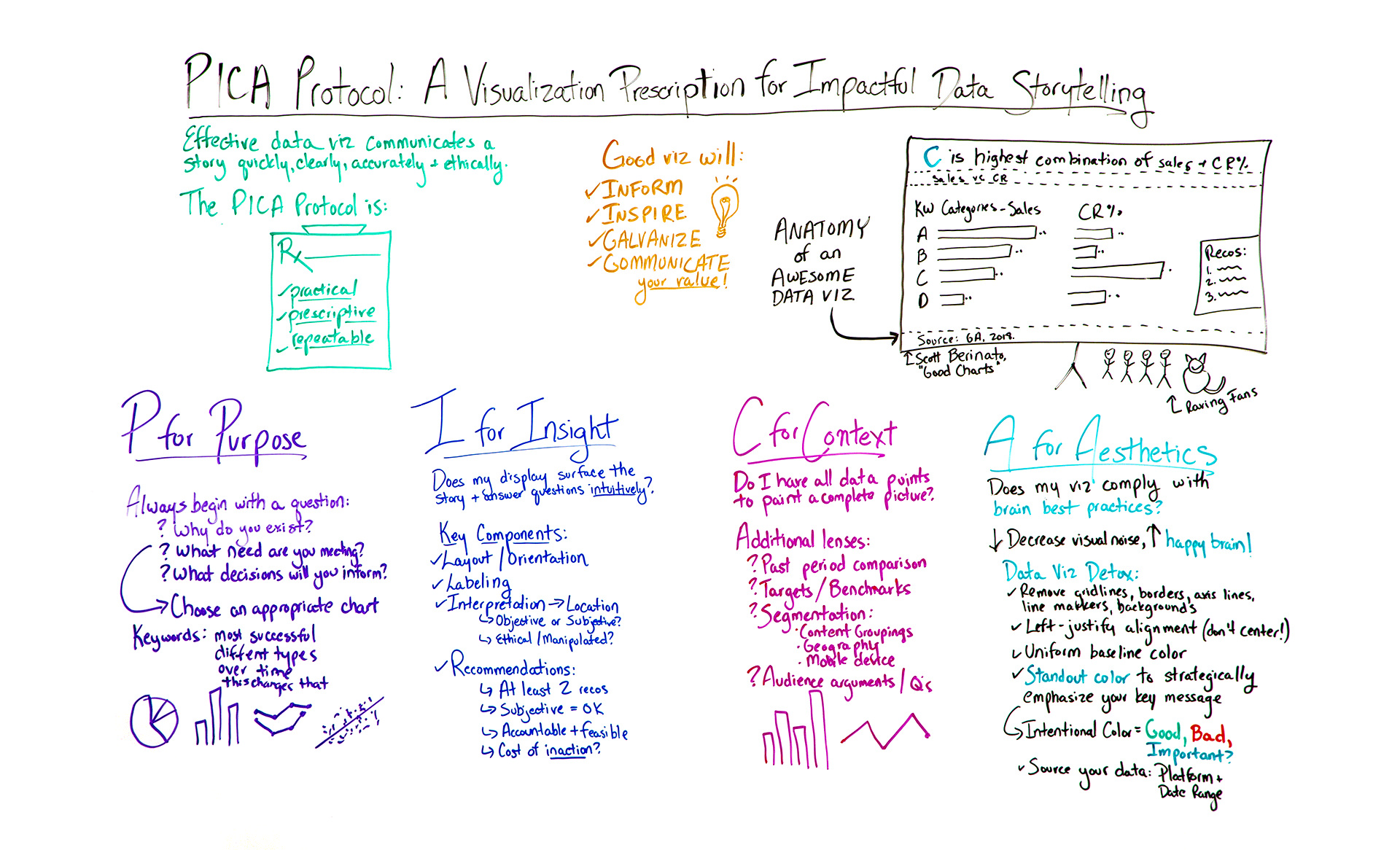
If you find your presentations are often met with a lukewarm reception, it's a sure sign it's time for you to invest in your data storytelling. By following a few smart rules, a structured approach to data visualization could make all the difference in how stakeholders receive and act upon your insights. In this edition of Whiteboard Friday, we're thrilled to welcome data viz expert Lea Pica to share her strategic methodology for creating highly effective charts.
Click on the whiteboard image above to open a high-resolution version in a new tab!
Video Transcription
Hello, Moz fans. Welcome to another edition of Whiteboard Friday. I'm here to talk to you this week about a very hot topic in the digital marketing space. So my name is Lea Pica, and I am a data storytelling trainer, coach, speaker, blogger, and podcaster at LeaPica.com.
I want to tell you a little story. So as 12 years I spent as a digital analyst and SEM, I used to present insights a lot, but nothing ever happened as a result of it. People fell asleep or never responded. No action was being taken. So I decided to figure out what was happening, and I learned all these great tricks for doing it.
What I learned in my journey is that effective data visualization communicates a story quickly, clearly, accurately, and ethically, and it had really four main goals — to inform decisions, to inspire action, to galvanize people, and most importantly to communicate the value of the work that you do.
Now, there are lots of things you can do, but I was struggling to find one specific process that was going to help me get from what I was trying to communicate to getting people to act on it. So I developed my own methodology. It's called the PICA Protocol, and it's a visualization prescription for impactful data storytelling. What I like about this protocol is that it's practical, approachable. It's not complicated. It's prescriptive, and it's repeatable. I believe it's going to get you where you need to go every time.
So let's say one of your managers, clients, stakeholders is asking you for something like, "What are our most successful keyword groups?" Something delightfully vague like that. Now, before you jump into your data visualization platform and start dropping charts like it's hot, I want you to take a step back and start with the first step in the process, which is P for purpose.
P for Purpose
So I found that every great data visualization started with a very focused question or questions.
Why do you exist? Get philosophical with it.
What need of my audience are you meeting?
What decisions are you going to inform?
These questions help you get really focused about what you're going to present and avoid the sort of needle in a haystack approach to seeing what might stick.
So the answers to these questions are going to help you make an important decision, to choose an appropriate chart type for the message that you're trying to convey. Some of the ways you want to do that — I hear you guys are like into keywords a little bit — you want to listen for the keywords of what people are asking you for. So in this case, we have "most successful." Okay, that indicates a comparison. Different types or campaigns or groups, those are categories. So it sounds like what we're going for is a categorical comparison. There are other kinds of keywords you can look for, like changing over time, how this affects that. Answers or opinions. All of those are going to help you determine your most appropriate visual.
Now, in this case, we have a categorical comparison, so I always go back to basics. It's an oldie but goodie, but we're going to do the tried-and-true bar chart. It's universally understood and doesn't have a learning curve. What I would not recommend are pie charts. No, no, no. Unless you only have two segments in your visual and one is unmistakably larger than the other, pie charts are not your best choice for communicating categorical comparison, composition, or ranking.
I for Insight
So we have our choice. We're now going to move on to the next step in the methodology, which is I for insight. So an insight is something that gives a person a capacity to understand something quickly, accurately, and intuitively. Think of those criteria.
So here, does my display surface the story and answer these questions intuitively? That's our criteria. The components of that are:
Layout and orientation. So how is the chart configured? Very often we'll use vertical bar charts for categorical comparison, but that will end up having diagonal labels if they're really long, and unless your audience walks around like this all the time, it's going to be confusing because that would be weird. So you want to make sure it's oriented well.
Labeling. In the case of bars, I always prefer to label each bar directly rather than relying on just an axis, because then their eyes aren't jumping from bar to axis to bar to axis and they're paying more attention to you. That's also for line charts. Very often I'll label a line with a maximum, a minimum, and maybe the most important data point.
Interpretation of the data and where we're placing it, the location.
So our interpretation, is it objective or is it subjective? So subjective words are like better or worse or stupid or awesome. Those are opinions. But objective words are higher, lower, most efficient, least efficient. So you really want your observations to be objective.
Have you presented it ethically? Or have you manipulated the view in a way that isn't telling a really ethical picture, like adjusting a bar axis above zero, which is a no-no? But you can do that with a line graph in certain cases. So look for those nuances. You want to basically ask yourself, "Would I be able to uphold this visual in a court of law or sleep at night?"
Location of that insight. So very often we'll put our insights, our interpretation down here or in really tiny letters up here. Then up here we'll put big letters saying this is sales, my keyword category. No. What we want to do is we want to put our interpretation up here. This top area is the most important real estate on your visual. That's where their eyes are going to look first. So think of this like a BuzzFeed headline for your visual. What do you want them to take away? You can always put what the chart is here in a little subtitle.
Make recommendations. Because that's what a really powerful visual is going to do.
I always suggest having two recommendations at least, because this way you're empowering your audience with a choice. This way you can actually be subjective. That is okay in this case, because that's your unique subject matter expertise.
Are your recommendations accountable to specific people? Are they feasible?
What's the cost of not acting on your recommendations? Put some urgency behind it. So I like to put my recommendations in a little box or callout on the side here so it's really clear after I've presented my facts.
C for Context
The next step in the methodology is C for context. What this is saying is, "Do I have all the data points I need to paint a complete picture, or is there more to this story?" So some additional lenses you might find useful are past period comparison, targets or benchmarks are useful, segmentation, things like geography, mobile device. Or what are the typical questions or arguments that your audience has when you present data? They can be super value contextual points.
In this case, I might decide that while they care about the number of sales, because that's most successful to them, I care about the keywords "conversion rates." So I'm going to add a second bar chart here like this, and I'm going to see there's a different story that's popping out here now.
Now, this is where your data storytelling really comes into play. This particular strategy is called a table lens or a side-by-side bar chart. It's what I recommend if you want to combine two categorical metrics together.
A for Aesthetics
Now, the last step in the methodology is A for aesthetics. Aesthetics are how things look. So it's not about making it look pretty. No, it's asking, "Does my viz comply with brain best practices of how we absorb information?"
1. Decrease visual noise
So the first step in doing that is we want to decrease visual noise, because that creates a lot of tension. So decreasing noise will increase the chance of a happy brain.
Now, I'm a crunchy granola hippie, so I love to detox every day. I've developed a data visualization detox that entails removing things like grid lines, borders, axis lines, line markers, and backgrounds. Get all of that junk out of there, really clean up. You can align everything to the left to make sure that the brain is following things properly down. Don't center everything.
2. Use uniform colors (plus one standout color for emphasis)
Now, you'll notice that most of my bars here have a uniform color — simple black. I like to color everything one color, because then I'll use a separate, standout color, like this blue, to strategically emphasize my key message. You might notice that I did that throughout this step for the words that I want you to pick out. That's why I colored these particular bars, because this feels like the story to me, because that is the storytelling part of this message.
Notice that I also colored the category in my observation to create a connective tissue between these two items. So using color intentionally means things like using green for good and red for bad, not arbitrarily, and then maybe blue for what's important.
3. Source your data
Then finally, you always want to source your data. That increases the trust. So you want to put your platform and your date range. Really simple.
So this is the anatomy of an awesome data viz. I've adapted it from a great book called "Good Charts" by my friend, Scott Berinato. What I have found that by using this protocol, you're going to end up with these wonderful, raving fans who are going to love your work and understand your value. I included a little kitty fan because I can. It's my Whiteboard Friday.
So that is the protocol. I actually have included a free gift for you today. If you click the link at the end of this post, you'll be able to sign up for a Chart Detox Checklist, a full printable PICA Protocol prescription and a Chart Choosing Guide.
I would actually love to hear from you. What are the kinds of struggles that you have in presenting your insights to stakeholders, where you just feel like they're not getting the value of what you're doing? I'd love to hear any questions you have about the methodology as well.
So thank you for watching this edition of Whiteboard Friday. I hope you enjoyed it. We'll see you next week, and please remember to viz responsibly, my friends. Namaste.
Sign up for The Moz Top 10, a semimonthly mailer updating you on the top ten hottest pieces of SEO news, tips, and rad links uncovered by the Moz team. Think of it as your exclusive digest of stuff you don't have time to hunt down but want to read!
In episode 183 of Semantic Mastery’s weekly Hump Day Hangouts, one participant asked what is considered over-optimization as far as SEO is concerned.
The exact question was:
What is considered over optimization as far as SEO? Having the exact title match the keywords I am trying to rank? Or tags? Besides Yoast, is there a site where I can input my post or article and check it to see if I am over optimized?